
1. Most Failures in Long AI Work Look Like Progress
Long AI-assisted projects rarely fail in a dramatic way. More often, they keep moving.
The draft gets cleaner. The plan becomes more detailed. The model sounds confident. A project that has been quiet for a week or a month can suddenly come back to life in a few seconds.
That ability is one of the most useful things about modern AI. It is also where a different class of failure appears.
Imagine a project with three versions of the same document. The first draft was reviewed. A reviewer found a real problem. The owner approved a narrow correction, and a patched version became the version everyone was supposed to use from that point forward. The old draft and the review were kept because they still mattered as history.
Then the project paused.
When work resumed, the model picked up the old draft because it was prominent in the conversation. It also saw the review and treated the reviewer’s recommendation as permission to make changes. The resulting document looked better than the old one. It was coherent, polished, and wrong in a way that was easy to miss: it had continued from the wrong project state.
Nothing about that failure required the model to forget the project. The relevant material could all be present. The problem was that the material did not all have the same meaning.
An old draft can still be useful without being current. A review can be correct without authorizing a revision. A newer file can exist without being approved. A completed artifact can still be private. A remembered decision can be accurate and still have been superseded later.
Once work lasts long enough to accumulate versions, approvals, reviews, dependencies, boundaries, and unresolved decisions, the project needs more than continuity of information. It needs continuity of control.
That changes the central question.
A model can usually answer: What seems useful to do next?
A governed project needs to answer: What is valid to do next?
Those are not always the same thing.
Governed Context Architecture, or GCA, is a framework for making that difference explicit. It treats long-horizon AI work as a sequence of governed state transitions rather than a conversation that simply keeps generating.
The central idea is straightforward: when the work can identify what governs now, what state the relevant artifact holds, what scope is authorized, and what action is valid next, continuation becomes much easier to inspect and recover.
The model can still draft, search, summarize, compare, retrieve, review, and automate. GCA does not slow those capabilities down for their own sake. It gives them a project state to work from.
That distinction begins with context itself.
2. From Context to Governed Context
In everyday AI use, context is the information available to the model while it responds: instructions, conversation history, documents, retrieved passages, tool results, notes, memory, examples, and prior outputs.
Modern Context Engineering treats that context as something that can be deliberately built and maintained rather than simply stuffed into one prompt. It can include instructions, tools, external data, history, compaction, note-taking, and other mechanisms that shape what an AI system has available while it works. [1]
For long projects, availability is only half the problem.
Suppose retrieval surfaces an early draft, a review of that draft, and a later corrected version. All three are relevant. Only one may be the current artifact. The review may explain why the correction happened. The early draft may still matter for provenance. But relevance alone does not tell the project which object should control the next action.
GCA calls the larger pool available context and distinguishes it from governed context.
Available context answers:
What information can the work use?
Governed context answers:
What information is allowed to control the work now?
That second question introduces relationships that ordinary context handling can leave implicit:
- current versus superseded;
- review versus authorization;
- draft versus approved artifact;
- internal completion versus release;
- historical information versus governing state;
- remembered information versus current control.
This does not mean old material should disappear. Long projects need history. They need earlier drafts, review records, rationale, source notes, and rejected alternatives. The goal is to keep that history available without letting it silently compete with the project’s current authority.
The distinction places GCA near current work on Context Architecture. The term is already being used for broader structures around how context, repositories, permissions, constraints, and source-of-truth relationships are organized around people and AI systems. [2] Current usage is still heterogeneous rather than one settled universal taxonomy. [3]
GCA occupies a narrower part of that space. Its concern is not simply how context is assembled, but how the project preserves the meaning of that context over time.
A useful way to see the difference is this:
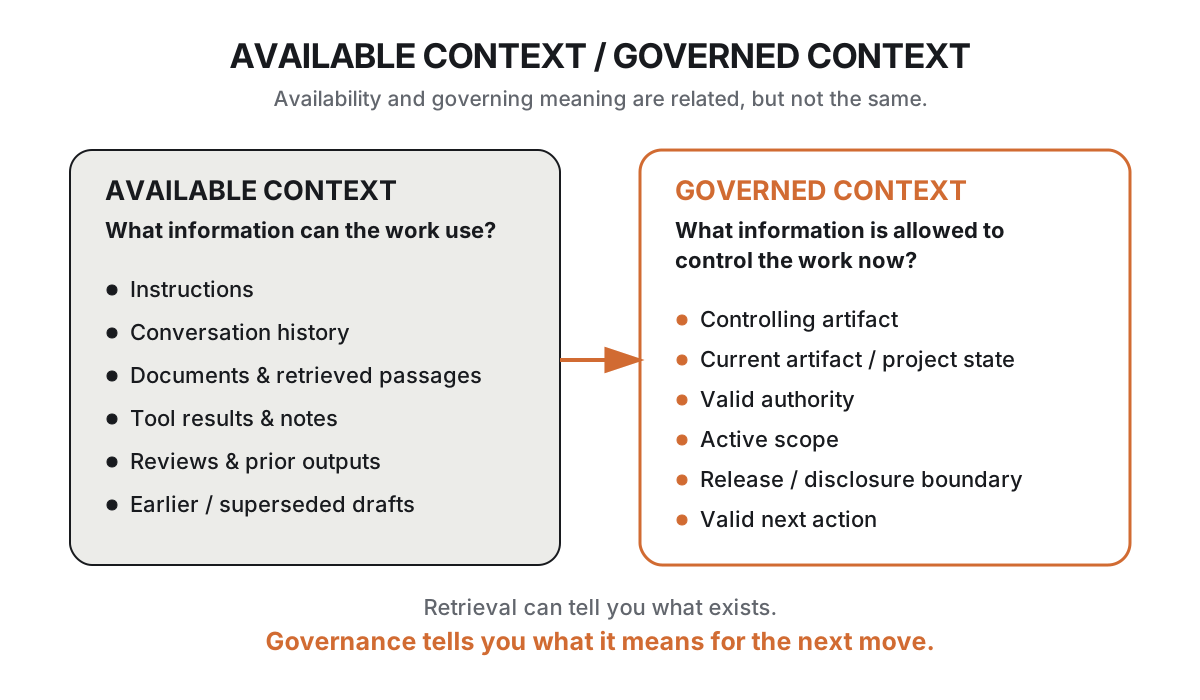
Retrieval can tell you what exists. Governance tells you what it means for the next move.
That same distinction applies to memory, version history, project-management tools, and knowledge systems. Each can preserve useful information. GCA asks the additional question that becomes unavoidable in long work: which of those records has authority now, and what does that authority permit?
A small project can answer that with a few notes. A larger project may encode it in structured records or software. The machinery can vary.
The governing problem does not.
3. What Governed Context Architecture Is
Governed Context Architecture is a practical framework for governing long-horizon AI-assisted work.
A concise definition is:
GCA is a governance-focused framework for making authority, artifact state, scope, and valid continuation explicit across long-lived AI-assisted workstreams.
Its unit of concern is not the isolated response. It is the workstream that develops across drafts, reviews, decisions, corrections, interruptions, handoffs, and releases.
That workstream contains objects with different roles. Some record history. Some define the current state. Some contain recommendations. Some carry approval. Some are safe for public use. Some are not. GCA gives those differences a durable structure so they can survive longer than the conversation that produced them.
Four terms help keep the framework portable:
Framework is the conceptual governance model: authority, state, scope, review boundaries, controlled change, supersession, recovery, and valid continuation.
Method is the set of practices used to apply that model: marking artifact state, maintaining current state, recording bounded changes, preserving supersession, and resolving what may happen next.
Implementation is one concrete way of carrying out those practices. It might use plain-text files, shared documents, repositories, metadata, databases, workflow tools, retrieval, or a mixture of them.
System is a larger operating environment that embeds those practices into software, automation, state infrastructure, or workflow controls.
Keeping those layers separate matters because the public framework should survive changes in tooling. A manual implementation can preserve GCA semantics well. A sophisticated system can still lose them if it lets relevance, automation, or recency stand in for authority.
It is not a replacement for prompting, retrieval, memory, version control, project governance, or human review. Those capabilities solve real problems and can all participate in a GCA implementation. GCA adds a governance layer across them: what does this material mean now, what state is the work in, what change is authorized, and what can validly happen next?
Nor is GCA a correctness engine. A governed draft can still contain factual errors, weak reasoning, or bad decisions. The framework governs continuation; it does not turn governance into truth.
GCA is positioned as a governance-focused framework in the broader context-architecture space. [4] Its contribution is to make the governance status of context and artifacts a first-class part of long AI-assisted work.
4. Core Control Model: Authority, State, and Scope
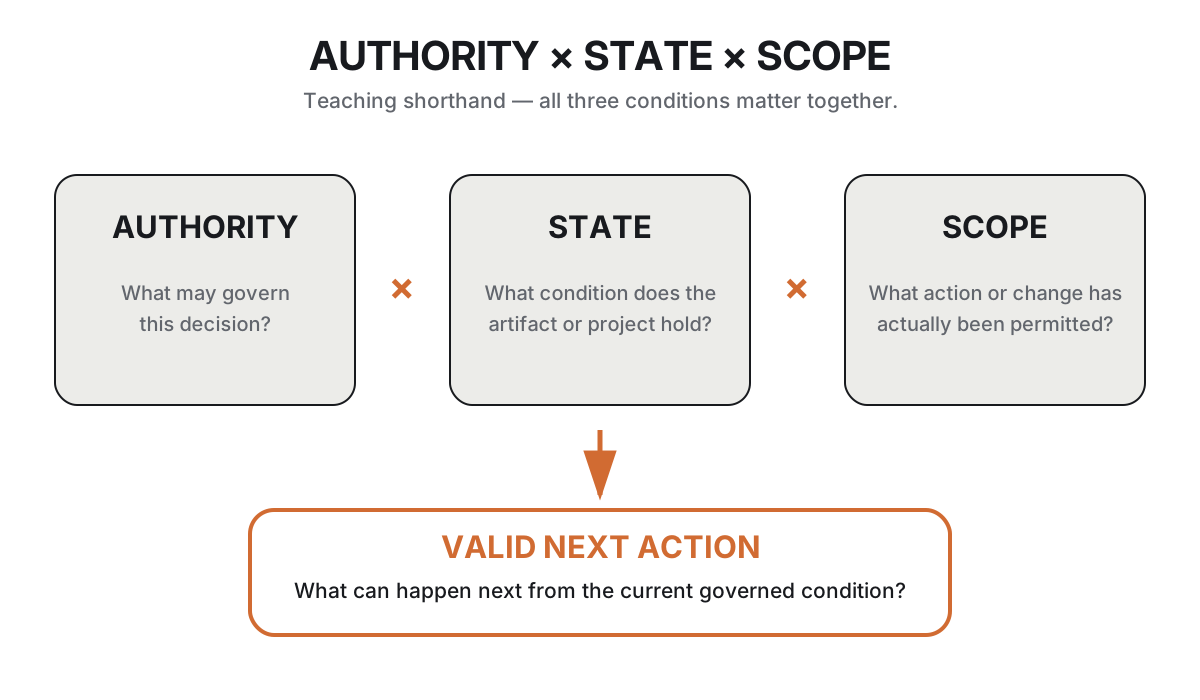
Before a consequential action changes the project, GCA resolves three things:
Authority — What may govern this decision?
State — What condition does the relevant artifact or project currently hold?
Scope — What action or change has actually been permitted?
Together they determine a fourth:
Valid Next Action — What can happen next from the current governed condition?
The relationship can be written as a teaching shorthand:
Authority × State × Scope → Valid Next Action
The multiplication sign is not mathematics. It simply emphasizes that all three conditions matter together.
Authority
Authority identifies the source, role, decision, or artifact that is allowed to control a particular question.
Authority is relational. A source can support a claim without governing the project. A reviewer can identify a defect without possessing approval authority. An approved section can govern downstream drafting for the concepts it establishes. A release decision can control whether an otherwise complete artifact may become public.
This is what prevents relevance from turning into control by accident.
State
State tells the project what condition an artifact currently holds.
The same text can mean different things depending on whether it is a draft, a review candidate, an approved artifact, a locked baseline, a superseded predecessor, or a released version.
State answers a question that text alone cannot:
What is this artifact currently allowed to be used for?
Scope
Scope limits what valid authority grants.
A review request may authorize inspection but not revision. A terminology patch may authorize one correction without opening the rest of the document for cleanup. Drafting authority may allow creation of a candidate without granting approval or release.
Scope matters because AI systems are excellent at helpful overreach. A model may notice ten improvements while performing one authorized correction. The extra nine may be sensible and still be outside the task.
Valid Next Action
Once authority, state, and scope are resolved, the project can identify what may happen next.
Sometimes that is drafting. Sometimes it is review, a bounded patch, verification, approval, or release preparation. Sometimes the correct result is to stop one mutation path until a missing decision is supplied.
The point is not to produce a universal workflow. The point is to prevent the project from inventing its own authority simply because a next step looks reasonable.
A compact operational check is enough for many projects:
1. What governs this decision? 2. What state is the relevant artifact in? 3. What am I allowed to change or do? 4. Given those answers, what is valid next?
Those questions become far more useful when their answers survive the conversation. That is the role of artifact state.
5. Artifact State: Turning Conversation into Durable Work
Conversation is excellent working memory. It is a poor substitute for durable project state.
A long project may accumulate drafts, reviews, approvals, patch records, source decisions, superseded versions, and release discussions. If those objects live only as conversational history, the project eventually has to infer what they mean every time it resumes.
Artifact state removes that guesswork.
A useful principle is:
Memory can recover information; explicit state tells the project what that information means now.
Persistent memory can retain useful project knowledge, retrieval can surface records, conversation logs can preserve history, and version-control systems can preserve changes over time. [5] GCA uses those capabilities where useful, then adds the governance relationship needed for continuation.
An artifact, in this framework, is any project object whose identity and meaning are intentionally preserved well enough to support later work. It might be a manuscript section, requirements document, plan, review record, source map, approval record, patch scope, current-state note, or release record.
What makes it durable is not the file format. It is the preservation of enough identity and state to tell the project what happened and what controls now.
Depending on the work, that may include:
- purpose or role;
- version;
- current state;
- governing authority;
- dependencies;
- unresolved findings;
- supersession relationship;
- valid next action.
Not every artifact needs all of those fields. The amount of state should match the consequence of getting continuation wrong.
Text, Version, and State
These are related but different.
Text tells you what the artifact says.
Version tells you which revision you are looking at.
State tells you what that revision means to the project now.
A v0.4 file can be current, experimental, rejected, awaiting review, or superseded. A v0.3 file can remain the controlling artifact even when v0.4 exists. A completed artifact can remain internal. A reviewed artifact can still have an unresolved patch.
Chronology helps with history. It does not replace governance.
Supersession
Supersession lets the project preserve history without forcing history to compete for current control.
When a successor becomes authoritative, the predecessor remains useful for provenance, comparison, and recovery. It simply stops governing the role that moved to the successor.
That distinction becomes especially valuable in retrieval-heavy systems because old artifacts can continue resurfacing long after they stopped controlling the project.
Current State as Compression
A project should not need to reread its entire history before every step.
A current-state record can compress the governing condition into a small surface: controlling artifact, current status, open findings, active boundaries, and valid next action.
That summary should point back to deeper records rather than replace them.
Think of it as a project’s control panel, not its archive.
If the control panel and the archive disagree, the contradiction needs to be resolved before the dependent mutation continues. The project can still inspect, compare, and diagnose while that happens.
The practical goal is simple: after an interruption, the project should be able to recover not only what happened, but what controls now.
6. Governed Continuation
AI makes continuation cheap. A model can resume a manuscript, extend code, revise a plan, or answer a review almost instantly.
GCA makes continuation deliberate.
The difference can be stated in two questions:
Ordinary continuation: What seems to come next?
Governed continuation: What is valid from the current project state?
Consider the earlier project. Weeks after the last session, the model can see an early draft, a later correction, review history, and several decisions. Without explicit state, it may resume from whichever artifact is most prominent. With explicit state, it can begin from the artifact that actually controls.
That is why resumption should start from state rather than from conversational momentum.
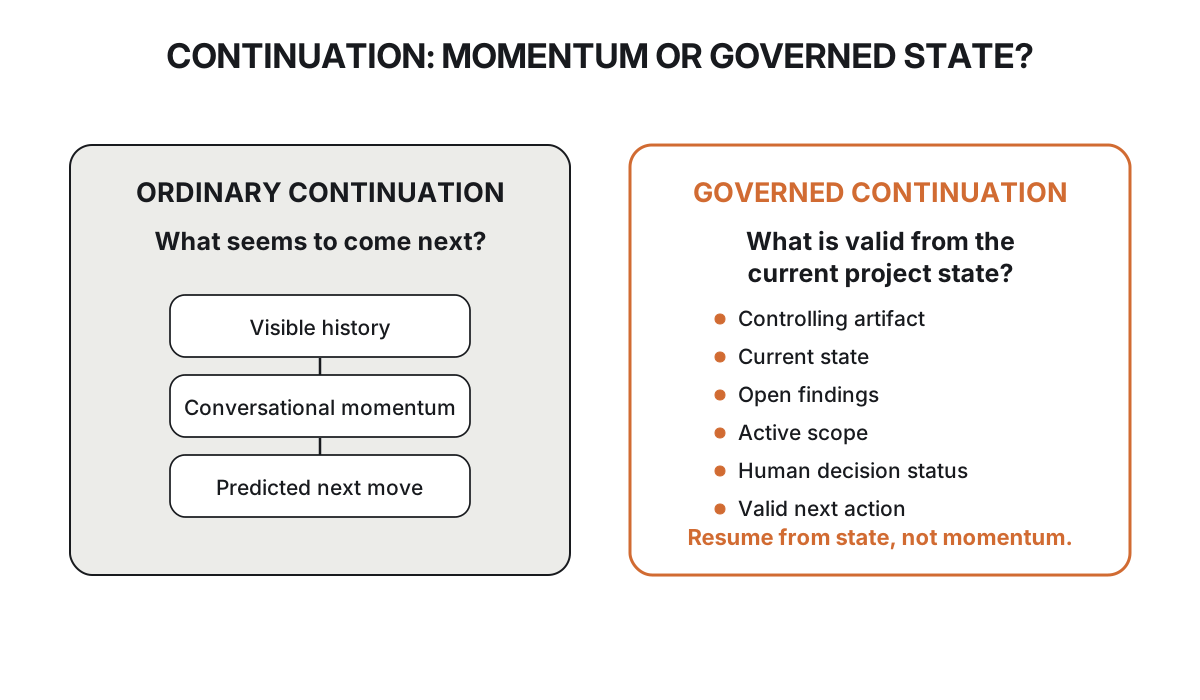
A useful restart surface answers:
- What is the current controlling artifact?
- What state does it hold?
- What findings remain open?
- What scope is active?
- Is any human decision still required?
- What is valid next?
That is often enough. The model does not need the entire project loaded at once if it can recover the governing path and retrieve deeper history when needed.
Governed continuation also changes how a project handles uncertainty.
If the controlling version cannot be established, the project should not guess and mutate anyway. It can inspect the evidence, compare records, prepare alternatives, or ask for the missing decision. The blocked action is the one whose validity depends on the unresolved state.
This makes a halt part of continuation rather than the opposite of it. Sometimes the most faithful way to continue a project is to refuse to move one step until the project knows which path is legitimate.
The same logic applies to automation. A workflow can execute a pre-authorized transition quickly and repeatedly. What it cannot do is turn its own ability to proceed into substantive authority.
Long-horizon work becomes more reliable when every restart begins from the same question:
Where is the governed project, not merely the conversation?
7. Review Is Not Revision
AI collapses review and editing into one effortless motion. It can notice a problem and rewrite the paragraph before a human has finished reading the finding.
GCA keeps those acts separate.
Review produces information about the artifact. Revision changes the artifact.
A review finding may identify an error, ambiguity, omission, sequencing problem, source problem, disclosure risk, or inconsistency. The finding can be excellent and still require a separate decision about what to do with it.
A simple classification helps:
KEEP — preserve the current artifact with respect to the finding.
TWEAK — the finding identifies a real defect that should enter a controlled correction path.
DISCARD — the finding is unsupported, redundant, out of scope, or based on a misreading.
The value of this distinction becomes obvious when a reviewer finds one genuine terminology defect and also suggests reorganizing two nearby paragraphs. The terminology issue may need correction. The restructuring may simply be an opinion. Treating both as equally authoritative turns review into silent redesign.
The same principle applies whether the reviewer is human or AI. Technical capability does not decide authority.
A healthy review cycle is therefore short and legible:
inspect → report → classify → authorize change → revise → verify
The clearer that chain is, the easier it becomes to understand why the resulting artifact changed and why the successor is allowed to control later work.
8. Controlled Change: Patches, Locks, Closure, Supersession
Once a correction is authorized, the project needs a change path that preserves the boundary of that authority.
A bounded patch is the simplest form. It names the defect, the artifact, the authorized correction, and any mechanically necessary propagation.
If one term is wrong, the patch can correct that term and its direct references. It does not automatically open the entire document for stylistic cleanup.
That boundary is useful because “while I’m here” edits are one of the easiest ways to lose traceability. A model can improve five unrelated things during a narrow correction and leave the project unable to separate required change from opportunistic change.
After mutation, verification answers a different question: did the authorized change happen correctly, and did anything outside scope change with it?
For small patches, a diff may be enough. Larger changes may justify focused review.
Several lifecycle terms then become important:
Approval accepts an artifact for a defined purpose or downstream use.
Lock establishes a baseline that should not be silently edited in place.
Closure means a governed work unit has satisfied its completion conditions.
Supersession transfers current control to a successor while preserving the predecessor as history.
Release authorizes an external or downstream distribution context.
These states can occur in sequence, but they are not synonyms.
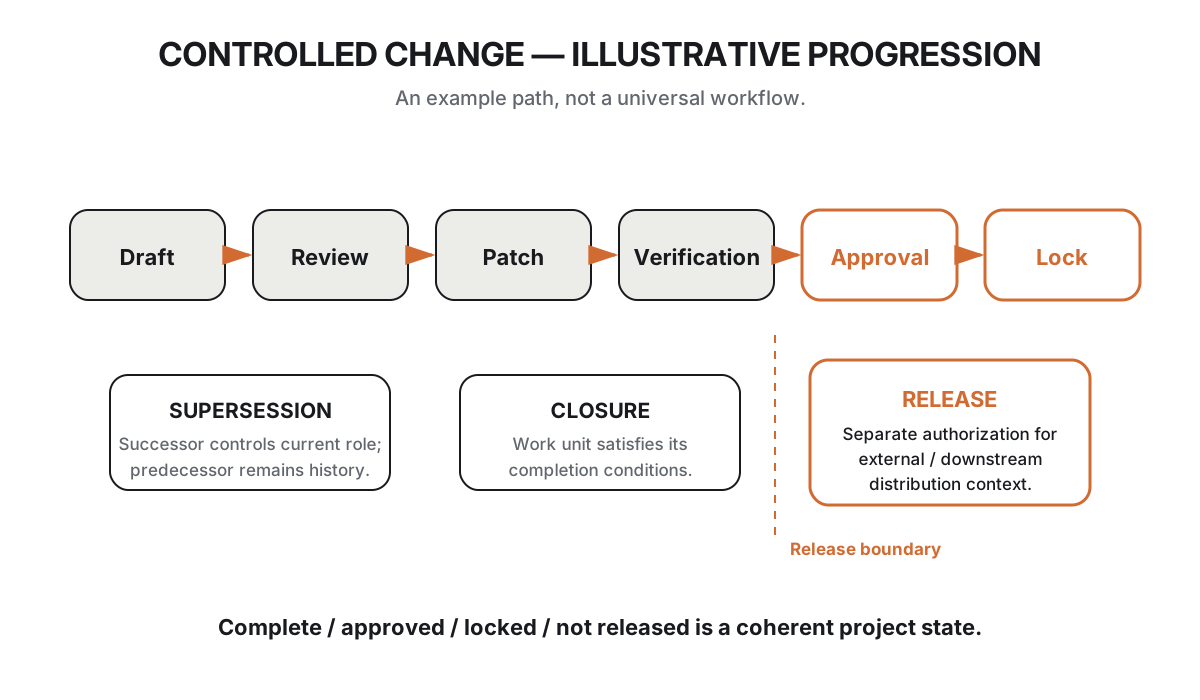
A useful example is a synthetic training package that has been drafted, reviewed, patched, verified, approved, and locked. Internal work may be complete. The package may still need disclosure review, accessibility work, brand review, or an explicit publication decision before it can be released.
So complete / approved / locked / not released is a perfectly coherent project state.
This is one of the places where GCA earns its keep: the project can be finished in one sense without pretending every downstream boundary has already been crossed.
9. Drift and Recovery
When long projects lose their governing relationships, they drift.
The output may remain polished. The project may even appear to accelerate. Drift describes the gap between that visible progress and the state that should have controlled it.
Common forms include:
- authority drift — background material begins governing the work;
- version drift — continuation moves from the wrong artifact;
- scope drift — a valid authorization is stretched beyond its boundary;
- terminology drift — key terms change meaning across the project;
- claim drift — a bounded statement becomes stronger as it is repeated or summarized;
- revision drift — a proposed correction enters the artifact without a valid change path;
- sequence drift — valid operations occur in the wrong order;
- release drift — completion or approval is mistaken for permission to publish or deploy.
These are practical categories, not a universal taxonomy. Their common feature is that the project loses the relationship between what exists and what should control.
The earlier scenario combines several of them. The model resumes from an older draft, treats review as authorization, and produces cleaner prose. The project improves locally while moving backward institutionally.
Recovery therefore needs to restore more than information.
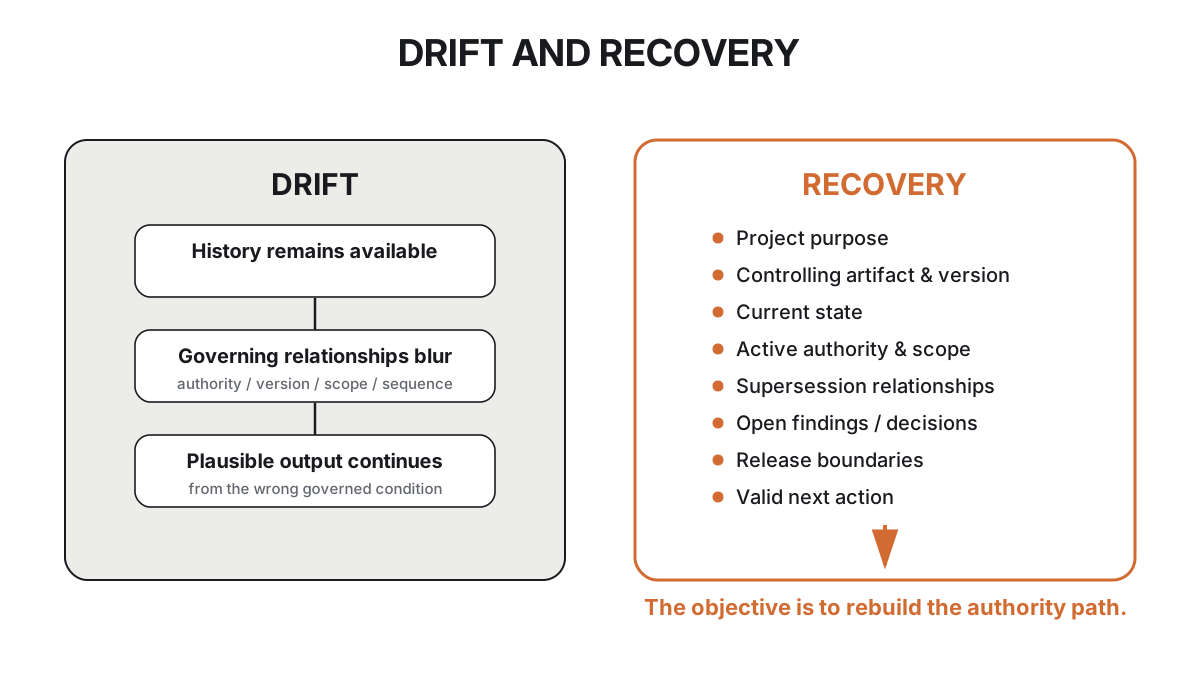
A useful recovery package can be surprisingly small if it restores the right things:
- project purpose;
- controlling artifact and version;
- current state;
- active authority and scope;
- important supersession relationships;
- unresolved findings or decisions;
- release or disclosure boundaries;
- valid next action.
The objective is to rebuild the authority path.
If that path is intact, the project can retrieve detailed history as needed. If the path is missing, loading more history may only make the ambiguity larger.
Sometimes recovery reveals a real contradiction: two records claim to be current, a later file has unknown status, or an approval cannot be verified. In that situation the uncertainty itself becomes part of state. The project can inspect and reconcile before resuming the dependent mutation.
This makes recoverability a design goal. A long project should not depend on one conversation remaining open forever, one model remembering every decision, or one person carrying the current state in their head.
A recoverable project can change tools, models, sessions, or people and still answer the same question: what governs now?
10. A Lightweight GCA Implementation
GCA can be useful without custom software.
For many projects, a small set of plain records is enough. The fictional Field Operations Training Manual below shows one workable starter pattern.
1. Purpose
Write down what the project is trying to produce.
Create a field operations training manual for new crew members that explains standard operating practices in a clear, usable form.
The purpose should be specific enough to constrain continuation without becoming a full specification.
2. Current State
Keep a short statement of what controls now.
Purpose approved. Outline v0.3 controls. Modules 1–2 drafted. Module 3 has an unresolved terminology finding. No release has been authorized.
A good current-state note is small enough to read quickly and precise enough to restart from.
3. Authority List
Name the records that currently govern important decisions: the approved purpose, controlling outline, current policy source, active review, or whatever else matters.
Historical files can remain nearby without being treated as current authority.
4. Artifact Status
Mark important artifacts clearly.
Module 3 / REVIEWED / PATCH REQUIRED / NOT APPROVED
The vocabulary can vary. The important thing is that status does not have to be inferred from the prose or filename.
5. Patch Log
For bounded corrections, record what was wrong, what was authorized, what changed, and whether the result verified cleanly.
This creates a visible bridge from finding to correction.
6. Supersession Note
State explicitly when one artifact replaces another.
Outline v0.2 is superseded by Outline v0.3. v0.2 remains historical and does not control new module drafting.
7. Valid Next Action
Write down what may happen next.
Apply the approved terminology correction to Module 3. Verify the changed locations. Do not restructure unrelated modules.
This is where Authority, State, and Scope become operational.
8. Public / Private Boundary
Identify material that should remain internal, confidential, security-sensitive, or otherwise excluded from public outputs.
The categories depend on the project. The boundary should not have to be rediscovered during every drafting pass.
9. Recovery Note
Tell the future project how to restart.
Verify the purpose, controlling outline, current-state note, review record, and valid-next-action statement before mutation resumes. Reconcile any conflict first.
Together, the nine controls are:
1. Purpose 2. Current State 3. Authority List 4. Artifact Status 5. Patch Log 6. Supersession Note 7. Valid Next Action 8. Public / Private Boundary 9. Recovery Note
The records should stay smaller than the work. A current-state note should not duplicate the manuscript. An authority list should not copy every source. A recovery note should not become a transcript.
The objective is control compression: enough governing information to restart the work without dragging the entire history into every decision.
When the project becomes larger—many artifacts, reviewers, dependencies, releases, handoffs, or automated workflows—the same semantics can move into more structured tooling.
11. From Lightweight Method to Full Implementation
GCA can scale in implementation without changing its core meaning.
A useful spectrum has four levels.
Level 1 — Manual
People maintain notes, status labels, reviews, approvals, and patch records directly.
This is portable and transparent, but it depends on discipline.
Level 2 — Structured
The project adds consistent metadata, naming, state vocabulary, dependency references, and authority identifiers.
Structure makes records easier to compare and easier to automate later.
Level 3 — Assisted
Software or AI helps retrieve governing records, compare candidates with controlling sources, flag conflicting state, prepare diffs, summarize open findings, or build recovery briefs.
The assistance reduces clerical work while the project’s authority model remains explicit.
Level 4 — Systemized
Governance semantics become part of an operating environment that coordinates artifacts, state transitions, workflow gates, dependencies, verification, recovery, and release controls.
Systemization can improve consistency at scale, but it also adds complexity. More automation is not automatically better governance.
A project can mix levels. Human approval may remain manual while artifact state is structured, review is assisted, and backups are automated.
The useful test is whether the governing meaning survives the machinery. If the project changes tools or hands work to another model or team, can the successor still identify what controls, what state the work is in, and what may happen next?
If yes, the implementation is carrying the framework rather than trapping it.
12. GCA in Practice: Applied Lineage and Examples
Five examples illustrate different parts of the framework. They carry different evidence classifications because they do different jobs: some show mechanisms, one carries bounded practitioner lineage, and none of them is empirical proof.
EX-1 — Progress Drift and Recovery
Classification: sanitized composite practitioner scenario / illustrative teaching demonstration.
EX-1 is the project that resumes from an older draft and treats review as authorization. It shows how context can remain available while the authority path is lost.
EX-2 — Review Without Silent Rewrite
Classification: synthetic teaching example.
EX-2 isolates the boundary between identifying a defect and gaining permission to revise it.
EX-3 — Supersession and Release Boundary
Classification: synthetic lifecycle teaching example / Evidence Class C.
EX-3 shows how a successor can become current while the predecessor remains historical, and how internal completion can stop short of release.
EX-4 — The One-Page Starter Pattern
Classification: independently created public teaching template.
The fictional Field Operations Training Manual demonstrates the nine lightweight controls.
EX-5 — The Map Is Public; the Control Room Is Not
Classification: public-safe explanatory teaching example.
EX-5 captures a practical disclosure principle: a framework can be taught publicly without publishing every private implementation detail used to operate it.
Taken together, the examples give the framework a common vocabulary. They cover drift, review, lifecycle state, lightweight adoption, and the public/private boundary.
Their classifications matter. A synthetic example teaches a mechanism. A sanitized practitioner scenario provides bounded lineage. Neither should quietly become an empirical performance claim.
That distinction leaves room for later research without turning teaching examples into evidence they were never meant to be.
13. Adjacent Practices and Where GCA Fits
GCA was not developed in an empty field. It sits beside several practices that already solve important parts of the context and workflow problem.
The clearest way to position it is by primary question.
Context Architecture
Current uses of Context Architecture describe broader structures around context-bearing systems, including repositories, source-of-truth relationships, permissions, constraints, and machine-legible context around people and AI agents. [6]
GCA fits inside that broader space as a governance-focused framework. Its question is what authority, state, and scope mean for continuation.
Context Engineering
Context Engineering focuses on building and maintaining the context available to AI systems: instructions, data, tools, history, compaction, notes, and other material that shapes model behavior. [7]
Its primary question is what context should be available and maintained?
GCA adds: what among that context governs the work now?
Prompt Engineering
Prompt Engineering focuses on constructing and optimizing model instructions and inputs. [8]
Prompts are one place governance rules can be expressed. Longitudinal project state, however, usually extends beyond any single prompt.
Retrieval-Augmented Generation
RAG retrieves external information to support generation. [9]
That is useful for finding source material and project records. GCA adds the distinction between retrieving an object and establishing its governance status.
Agent Memory
Memory systems preserve or retrieve information across interactions and sessions. [10]
They support continuity and can also store governance metadata. GCA’s concern is that the meaning of the remembered information remain resolvable when the project resumes.
Version Control
Version control records changes over time and supports comparison, history, branching, and recovery. [11]
GCA uses that history but adds questions such as which version controls, whether a change was authorized, and what downstream action the current state permits.
Knowledge Management
Knowledge-management standards and practices focus on how organizations create, maintain, share, and use knowledge. [12]
GCA overlaps where durable organizational knowledge becomes part of an active AI-assisted workstream, while staying focused on continuation from governed project state.
Project Governance
Project governance provides structures for directing, controlling, overseeing, and assigning responsibility across project work. [13]
GCA applies that governance mindset to a specific continuity problem created by long AI-assisted work: many relevant artifacts can remain available after their authority has changed.
Human-in-the-Loop Workflows
Human-in-the-loop systems can pause execution for human input or approval and later resume. [14]
GCA places that approval inside the project’s wider state: what artifact the decision applies to, what scope it grants, what remains unresolved, and what becomes valid afterward.
A compact comparison is useful:
| Practice | Primary question | GCA adds |
|---|---|---|
| Context Architecture | How is the context-bearing environment structured? | Governance semantics for continuation |
| Context Engineering | What context should be available and maintained? | What available context governs now |
| Prompt Engineering | How should instructions be constructed? | Longitudinal authority and state |
| RAG | What information should be retrieved? | Governance status of retrieved material |
| Agent Memory | What should persist or be recalled? | Meaning of persistence for current control |
| Version Control | How are changes and versions recorded? | Approval, state, scope, valid next action |
| Knowledge Management | How is organizational knowledge managed? | Governed AI-assisted workstream continuity |
| Project Governance | How is project work directed and controlled? | Governance applied to context and artifact continuity |
| Human-in-the-Loop | When should humans intervene or approve? | Approval embedded in wider project state |
These practices are complementary. A strong implementation may use several of them at once.
GCA’s narrow contribution is the question that cuts across the entire stack:
What is this available material allowed to mean for the work now?
14. Limits, Tradeoffs, and When GCA Is Overkill
Governance has a cost.
Every state marker, approval boundary, patch record, recovery check, and source-of-authority note consumes attention. Used carelessly, governance can become its own source of friction.
The proportionality rule is therefore central:
Use enough governance to match the consequence of getting continuation wrong.
Many AI interactions need almost none. A one-off rewrite, casual brainstorm, disposable explanation, or short creative exercise usually does not need durable state. If the output can be regenerated with little consequence, formal governance may cost more than it saves.
The need grows when decisions accumulate and later work depends on them: multi-month writing, research, software planning, policy work, operations, regulated environments, client deliverables, or projects with multiple reviewers and release boundaries.
Over-governance is a real failure mode. Too many states become hard to understand. Too many approvals shift attention from the work to the process. Excessive records go stale. Formal-looking controls can create false confidence.
The goal is legibility, not ceremony.
GCA also cannot make bad decisions good. A human can approve weak work. A current-state record can be wrong. A team can encode an unhelpful rule. Automation can apply a bad rule faster than a person could.
And governance does not replace the disciplines that establish substantive quality. It does not eliminate hallucination, bias, insecure code, unsafe recommendations, poor reasoning, or missing domain expertise. It does not replace security engineering, privacy controls, compliance, legal review, risk management, or records-retention policy.
Empirical performance remains an open question. The examples explain the framework; they do not prove measured reductions in drift, faster recovery, productivity gains, lower error rates, return on investment, or superiority across models and domains.
Those are testable questions, not conclusions to smuggle into the framework.
A practical cost test is enough for adoption:
If losing authority, state, scope, or release control would be expensive enough to matter, make those relationships explicit.
If not, keep the process light.
15. Conclusion — Governed Continuation
AI makes it easy to keep going.
That changes what long projects need from us.
The problem is no longer only whether a model can remember enough, retrieve the right document, or generate a useful next answer. Once a project accumulates real decisions, versions, reviews, approvals, and release boundaries, continuation itself becomes something that has to be governed.
GCA starts from one distinction: available context and governing context are not the same thing.
From there, the framework asks four practical questions:
What has authority?
What state is the work in?
What scope is permitted?
What action is valid next?
Those questions are simple enough to use in a folder of text files and strong enough to organize a much larger system.
They also change how we think about failure. A project does not have to crash to lose control. It can drift while producing cleaner output. It can preserve every old message and still forget which decision governs. It can retrieve the right file and use it in the wrong state. It can finish an artifact and release it before release was ever authorized.
Governed continuation makes those relationships visible.
It lets important artifacts survive interruption with their meaning attached. It keeps review distinguishable from revision, bounded change distinguishable from redesign, history distinguishable from current control, and completion distinguishable from release.
That is the practical promise of GCA.
Not perfect generation.
Governed continuation.
Endnotes
1. Anthropic Engineering, “Effective context engineering for AI agents” (September 29, 2025); Hangfei Lin, “Architecting efficient context-aware multi-agent framework for production,” Google Developers Blog (December 4, 2025). 2. Sergio Azócar, Context Architecture: software architecture for people and AI agents (first published June 2026); Phoebe Sajor, “No Dumb Questions: What is AI context architecture? Why not just build your own?” Stack Overflow (August 14, 2026). 3. Azócar, Context Architecture; Sajor, “No Dumb Questions.” 4. Azócar, Context Architecture; Sajor, “No Dumb Questions.” These sources support the surrounding Context Architecture positioning space; GCA’s framework definition remains author-defined. 5. Microsoft Foundry, “What is Memory?” (last updated June 2, 2026); Scott Chacon and Ben Straub, Pro Git, 2nd ed., “About Version Control” (2014; live web edition). 6. Azócar, Context Architecture; Sajor, “No Dumb Questions.” 7. Anthropic Engineering, “Effective context engineering for AI agents”; Lin, “Architecting efficient context-aware multi-agent framework for production.” 8. Amazon Web Services, Prescriptive Guidance, “Prompt Engineering Glossary.” 9. Amazon Web Services, Prescriptive Guidance, “Understanding Retrieval Augmented Generation.” 10. Microsoft Foundry, “What is Memory?” 11. Chacon and Straub, Pro Git, 2nd ed., “About Version Control.” 12. International Organization for Standardization, ISO 30401:2018 — Knowledge management systems — Requirements (published November 2018). 13. Project Management Institute, Governance of Portfolios, Programs, and Projects: A Practice Guide (January 2016); Salina Sandra Alie, “Project governance: #1 critical success factor” (October 10, 2015). 14. Microsoft Agent Framework Workflows, “Human-in-the-loop (HITL)” (last updated August 25, 2026); Microsoft Agent Framework, “Using function tools with human in the loop approvals” / tool approval guidance (last updated August 25, 2026).
References
- Alie, Salina Sandra. “Project governance: #1 critical success factor.” Project Management Institute. October 10, 2015. https://www.pmi.org/learning/library/project-governance-critical-success-9945
- Amazon Web Services, Prescriptive Guidance. “Prompt Engineering Glossary.” Accessed September 4, 2026. https://docs.aws.amazon.com/prescriptive-guidance/latest/llm-prompt-engineering-best-practices/glossary.html
- Amazon Web Services, Prescriptive Guidance. “Understanding Retrieval Augmented Generation.” Accessed September 4, 2026. https://docs.aws.amazon.com/prescriptive-guidance/latest/retrieval-augmented-generation-options/what-is-rag.html
- Anthropic Engineering. “Effective context engineering for AI agents.” September 29, 2025. https://www.anthropic.com/engineering/effective-context-engineering-for-ai-agents
- Azócar, Sergio. Context Architecture: software architecture for people and AI agents. First published June 2026. https://context-architecture.dev/
- Chacon, Scott, and Ben Straub. Pro Git. 2nd ed. “About Version Control.” 2014; live web edition. https://git-scm.com/book/en/v2/Getting-Started-About-Version-Control
- International Organization for Standardization. ISO 30401:2018 — Knowledge management systems — Requirements. Published November 2018. https://www.iso.org/standard/68683.html
- Lin, Hangfei. “Architecting efficient context-aware multi-agent framework for production.” Google Developers Blog. December 4, 2025. https://developers.googleblog.com/architecting-efficient-context-aware-multi-agent-framework-for-production/
- Microsoft Agent Framework. “Using function tools with human in the loop approvals” / tool approval guidance. Last updated August 25, 2026. https://learn.microsoft.com/en-us/agent-framework/agents/tools/tool-approval
- Microsoft Agent Framework Workflows. “Human-in-the-loop (HITL).” Last updated August 25, 2026. https://learn.microsoft.com/en-us/agent-framework/workflows/human-in-the-loop
- Microsoft Foundry. “What is Memory?” Last updated June 2, 2026. https://learn.microsoft.com/en-us/azure/foundry/agents/concepts/what-is-memory
- Project Management Institute. Governance of Portfolios, Programs, and Projects: A Practice Guide. January 2016. https://www.pmi.org/standards/governance
- Sajor, Phoebe. “No Dumb Questions: What is AI context architecture? Why not just build your own?” Stack Overflow. August 14, 2026. https://stackoverflow.blog/2026/08/14/ndq-ai-context-architecture-build-buy/